The email address in "Contact AK: Ads and more" above will vanish from November 2018.

PRIVACY POLICY

FAKE ASSI AK71 IN HWZ.

Featured blog.

1M50 CPF millionaire in 2021!

Ever since the CPFB introduced a colorful pie chart of our CPF savings a few years ago, I would look forward to mine every year like a teena...

Past blog posts now load week by week. The old style created a problem for some as the system would load 50 blog posts each time. Hope the new style is better. Search archives in box below.

Archives

"E-book" by AK

Second "e-book".

Another free "e-book".

4th free "e-book".

Pageviews since Dec'09

Financially free and Facebook free!

Recent Comments

ASSI's Guest bloggers

Golden Agriculture: 56c support.

Thursday, September 30, 2010

Golden Agriculture seems to have found support at 56c. As the falling MACD made contact with zero, the histogram turned green: a buy signal.  Today's white candle is on the back of relatively low volume and that to me is not convincing of a recovery. However, this does not mean that price could not enjoy a respite and rebound.  If a rebound takes place, it would confirm the buy signal on the MACD histogram but could meet with immediate resistance at 57.5c.

Well, 56c is only one bid shy of 55.5c which is where we find the rising 200dMA which coincides with the uptrend support line.  This is, therefore, likely to be a rather strong support.  So, buying at 56c for anyone who would like to have a stake in Golden Agriculture seems fairly safe.  Personally, I am waiting for the dust to settle.

Related post:
Golden Agriculture: Breaking support.

Courage Marine: Lengthy consolidation.

A friend asked me what I think of Courage Marine and I told him I like its numbers and I like how the BDI seems to have stabilised at $2,500 thereabouts.  I feel that Courage Marine shouldn't have bad news with regards to earnings. The main reason why I have not really talked about Courage Marine very much recently is the lack of anything newsworthy.


Courage Marine's share price seems to be going through a lengthy consolidation period.  Nothing exciting either way. OBV is flat which indicates a lack of any distribution or accumulation activities. Seems like status quo to me. The MFI still suggests the presence of demand while the RSI has bounced off the 50% mark which suggests some buying momentum is present.

The 20d, 50d and 100d MAs have all merged at 19c.  19c could either become a strong support or a strong resistance in such a case. Which way would it go? Well, we have a buy signal on the MACD histogram and with the MFI and OBV more positive than negative, I would hazard a guess: up. In such an instance, I see resistance at 20c, 21c and 23c.  Good luck to my friend and fellow shareholders.

Related post:
Courage Marine: Awakening.

Genting SP: An orderly retreat.

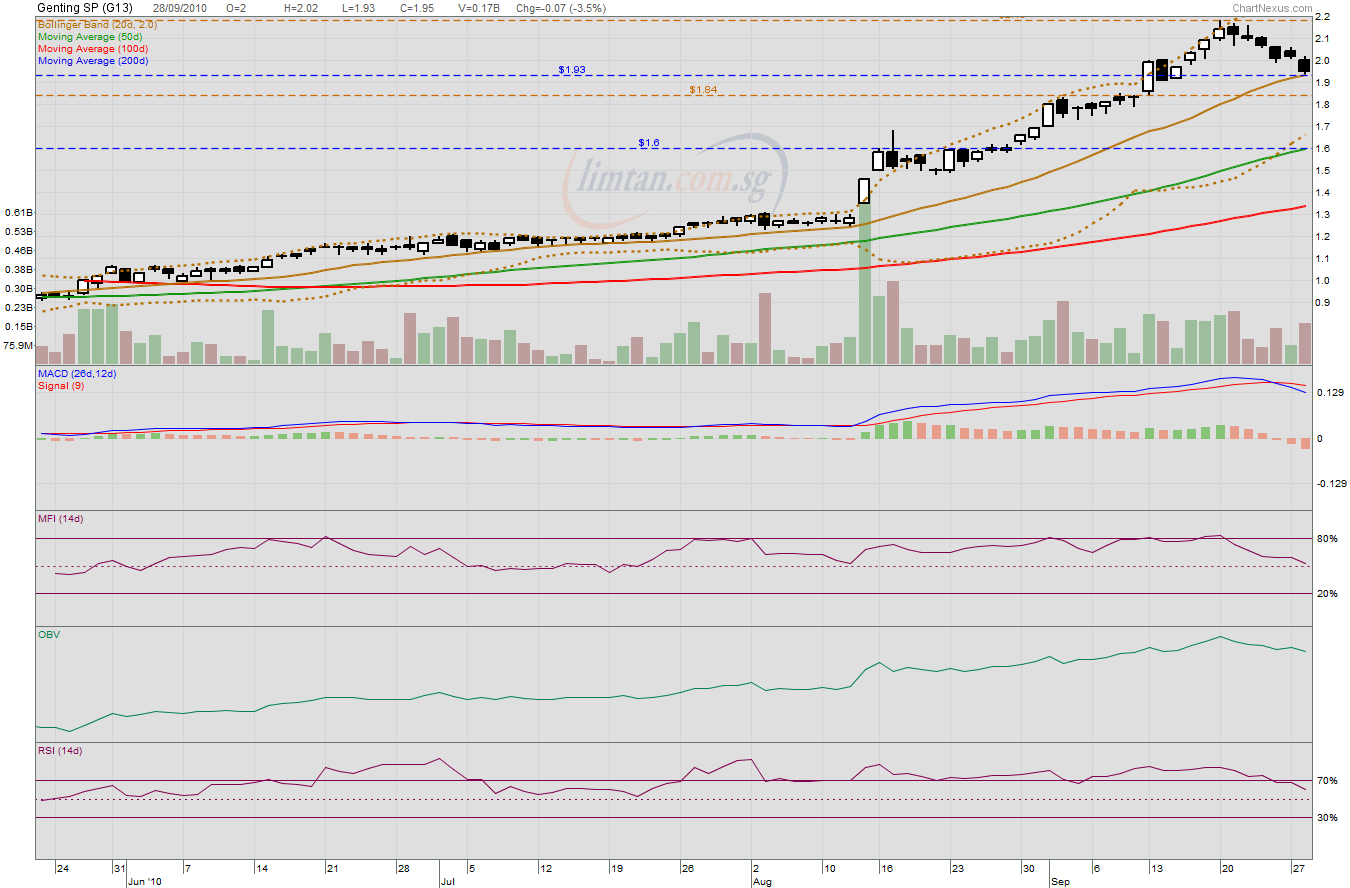
No one likes to see his investment plunging in value but anyone who bought some Genting SP's shares towards the end of its run up to $2.18 could be nursing a huge paper loss now, if he did not cut his losses.

On 28 Sep, I mentioned that "we could see more selling pressure in the near term.  If $1.93 gives way, I see the next support level at $1.84, give or take a cent. Strong support should be provided by the rising 50dMA which is currently at $1.60." Today, price action formed a low at $1.85, just a cent shy of $1.84, before closing at $1.86.  That >5m shares were sold down at $1.86 post closing at 5.05pm suggests more downside to come.


The momentum oscillators are firmly downward moving and the OBV shows clear distribution underway.  It would seem that the 50dMA would be called upon as support in due course. What price would that be at?  If I were to hazard a guess, it could be close to $1.70 next week.  That is where we find the lower Bollinger band and it also seems like a natural candlestick support.  Of course, a nice round number is mostly psychologically important.

Do I expect any panic selling? That's a tough one to answer but looking at the volume of trade as the stock was sold down this week, it looks like an orderly retreat to me.  No spike in trade volume.  So, this is perhaps a consolation for shareholders.

Related post:
Genting SP: CEO pares stake.


CIT: Show me the numbers.

I was asked by some if the proposed purchase by Cambridge Industrial Trust (CIT) is a good move. I went to SGX and downloaded the document on: PROPOSED ACQUISITION OF 25 TAI SENG AVENUE.

The property is valued at S$21.5m but is being sold at $21.1m to CIT and CIT has "sufficient financial flexibility and capacity to fund the Acquisition which is expected to complete by 4th quarter of 2010" which I interpret to mean that they do not need to do a share placement or rights issue.

I would rather like to have some numbers so that I could see if this purchase is income yield accretive but unfortunately, these numbers are not available.  Instead, the managers just say:

"The Manager believes that 25 Tai Seng Avenue is a quality industrial asset that has been purchased at an attractive yield which is comparable or better than yields of recent  transactions in the market.

"Additionally, the acquisition of 25 Tai Seng Avenue will further reduce the reliance of CIT’s income stream on any single asset and tenant, increase the weighted average lease tenure of CIT’s portfolio as at 30 June 2010 and reduce CIT’s lease expiry concentration in 2013 and 2014."


Can't do much analysis without the necessary numbers.

Saizen REIT: Divestment of properties.

Wednesday, September 29, 2010

Saizen REIT has managed to divest another four properties in its YK Shintoku portfolio.  A friend asked me if this is a good thing and my answer was an unequivocal "yes".  Why?

1. The plan to divest some properties of YK Shintoku to reduce the borrowing amount is with approval from the CMBS lenders. This shows that the lenders have no wish to foreclose YK Shintoku and would rather have their money back. In the meantime, they enjoy a rich 7.07% interest payment on the loan amount.

2. Saizen REIT's management is currently in negotiations with financial institutions to refinance YK Shintoku's loan and by divesting some properties, its absolute loan quantum is smaller and this makes it more palatable to potential lenders.  Like I mentioned before, a successful re-financing of YK Shintoku's loan would most likely result in a much lower interest rate which would lead to a positive re-rating of the REIT.

3. The properties divested are at smallish discounts to their most recent valuations.  The discounts are at 0.2%, 3.7%, 5.3% and 6.1% for the four different properties. This demonstrates the return of buying interest in the Japanese real estate sector as investors seek out better returns for their money.  This bodes well for Saizen REIT as the apartment buildings that they own are below replacement value.  This means that investors are unlikely to build new and would rather seek to buy in the resale market.

Following the loan repayment using sale proceeds from the divestments, the remaining balance of YK Shintoku's loan is estimated to be approximately JPY 6.6 billon (S$103.6 million). The loan was JPY 7.1billion (S$111.5 million) before.

See announcement here.

Related post:
Saizen REIT: Emphasis of matter.

Gold can double from here over the next 5 years.

"Despite all the hype about its multi-year rally, gold is actually lagging many other commodities in that it hasn't yet eclipsed its 1980 high on an inflation-adjusted basis, Holmes says, noting the same is true of silver."


Posted Sep 28, 2010 12:00pm EDT by Aaron Task

Gold hits another record high of US$1,308.00, the eighth time it has hit a new high in the last two weeks!  Read article here.

Related posts:
Buy more silver on weakness. 
Real value of gold.

SPH: Closing above $4.20.

SPH experienced a nice white candle day with price closing at $4.21.  This is the first time it has closed above the $4.20 resistance level in more than two years. That this took place on the back of volume expansion (volume was three times more than the previous session) gives hope that we could possibly see higher prices in the near future.


The higher highs in the OBV shows continual accumulation.  The MFI has formed a higher low and being at a very low level now, it has much room to rise before becoming overbought. The MACD has turned up and seems poised for a bullish crossover with the signal line.

Immediate support is now at $4.16 as provided by the 20dMA.  Immediate target is $4.30.

Related post:
SPH: $4.20 is still resistance.

K-REIT: In retreat.

Tuesday, September 28, 2010

The overbought buying momentum in K-REIT was corrected today as the RSI slipped out of overbought territory.  OBV shows that the trend of accumulation is intact and the MFI still shows rather strong demand.  So?  I won't be overly concerned with the selling down.


Immediate support is at $1.26 which is where we find the 20dMA.  Any further selling should find the next support level at $1.22, the top of a consolidation formation and this is also where we find the 50dMA approximating.  If $1.22 should give, which could, of course, happen, the next support is at $1.16.

Related post:
K-REIT: Moving into the next band?

Saizen REIT: Cheaper please.

Quite recently, in LP's cbox, I mentioned that I was watching Saizen REIT like a hawk, believing that there would be some people who would lose patience and sell down their stakes. Today, it happened and I was waiting at 15c.  Buying at 15c is similar to what we would have paid for Saizen REIT last year in December.


Saizen REIT was sold down heavily, most of it at 15.5c, today for whatever reason. The lack of interest by the market at large in this counter is quite obvious as the MACD has been hugging the signal line. At below zero, the momentum is clearly negative.  The MFI has been forming lower highs, a sign of flagging demand. RSI shows a slowing of buying momentum. 16c could possibly be a strong resistance now as that is where all the MAs are approximating.

The annual report would be out soon and I would take some time to go through it but I doubt I would find anything unexpected.  Value is what we get and price is what we pay.  If Mr. Market is willing to sell to me an undervalued stock at a lower price, I would graciously (or greedily) accept.

AIMS AMP Capital Industrial REIT: Cheaper please.

AIMS AMP Capital Industrial REIT's unit price declined today to hit a low of 21c. I was in the buy queues at 21.5c and 21c.  Didn't manage to get any at 21c.  With an estimated DPU of 2.08c, buying at 21.5c gives a yield of 9.67%.


Looking at the charts, I mentioned to some friends that getting some at 21c or even 20.5c is a distinct possibililty although 21.5c is psychologically important as it is the midpoint of the old trading range of 20c to 23c. I am keeping some powder dry as buying at 21c would give a yield of 9.9% while getting some at 20.5c, which is where we find the 100dMA, would give a yield of 10.15%!

Then, why not I wait for 20.5c and be done with it?  Well, TA only shows us the probable scenarios, not definite results. I always hedge. 9.67% yield is more than decent to me and quite acceptable.

Genting SP: CEO pares stake.

Genting SP rocketed to a high of $2.18 on 20 Sep which was also the day when OBV peaked and the MFI formed a higher high.  However, all parties come to an end or at least they need a break.  Genting SP's share price has retraced to support provided by the 20dMA at $1.93.  Will this support level hold? Or will we see more downside?


That the CEO sold down his stake to the tune of 900,000 shares yesterday at $2.047 each does not inspire much confidence in investors. We could see more selling pressure in the near term.  If $1.93 gives way, I see the next support level at $1.84, give or take a cent. Strong support should be provided by the rising 50dMA which is currently at $1.60.


Hock Lian Seng: 32c target.

Monday, September 27, 2010

Hock Lian Seng seems to be forming steps with the rising 20dMA pushing up the price at every step. The rising 20dMA would be at 30c soon.  A support seems to have formed at 30c for this construction stock.  Further upside would give a target of 32c.


While the OBV shows constant accumulation, the MFI shows lower highs forming.  So, accumulation is taking place amid lowering demand.  Not a powerful statement. A slow grind up is perhaps what we would see for this counter.

Related post:
Hock Lian Seng: Resistance broken.

FSL Trust: Rising from the depths.

It has been a while since I looked at FSL Trust. Today, it rose decisively.  Price action formed a wickless white candle, opening at 43.5c and closing at 45c. However, lacking in volume, one wonders if it would go on rising.


The rising 20dMA recently formed a golden cross with the 100dMA and this marks a strong support at 42c. Trading above the gap which was closed at 43.5c now brings the next resistance at 46c to play.  I see an eventual target as defined by the descending 200dMA, currently at 51c.

Related post:
FSL Trust: Where to from here?
FSL Trust: The skies are clearing up.

Golden Agriculture: Breaking support.

CPO price is at RM2,735, up RM34 or up 1.26%.  All CPO counters are up with the exception of Golden Agriculture which is affected by bad press.  It could potentially lose more customers.

On 25 Sep, I mentioned that "with the recent bad press and uncertainty as to whether things would worsen, it might be better to err on the side of caution and to stay sidelined".  Support at 57.5c gave way in this session as the counter closed at 56.5c, forming a bearish engulfing candle. Volume more than tripled compared to the previous session, a white candle day which I described as lacking in conviction.


The MACD continues plunging, increasing its distance from the signal line, as it heads towards zero.  MFI and RSI both formed lower highs with the latter breaking 50% as it heads lower.  OBV shows ongoing distribution. Technically weak, this counter could head lower unless there is some positive catalyst.

Next support level is at 55c, where we find the 100d and 200d MAs.  I have divested my remaining stake at 57.5c as the support broke and will wait for the dust to settle before deciding on re-entry.

Related post:
Golden Agriculture: Stay cautious.


Office S-REITs VS Industrial S-REITs.

Sunday, September 26, 2010

An earlier blog post on FCOT, CCT and K-REIT attracted much attention and many comments.  A friend asked me offline if I would invest in any of these REITs.  

Well, I have some pre-historic investments in FCOT and K-REIT while my investment in CCT was divested a few months back.  

Although I am not enthusiastic about office S-REITs, I am aware of what analysts are saying about how office rentals have bottomed in Singapore and that things are looking up.  So, office S-REITs should perform better from now.  The operative word here is "should".


Looking at the numbers, I still very much prefer industrial properties S-REITs and regular readers would know that I favour AIMS AMP Capital Industrial REIT (AA REIT).  With an XR DPU of 2.08c, its yield is 9.45% at the latest closing price of 22c. XR gearing level is 34.8%.  

With an interest cover ratio of 4.21x (correct as of 22 June 2010), it easily trumps CCT's 3.8x, K-REIT's 3.6x and, of course, FCOT's 2.74x.  

Furthermore, AA REIT's latest acquisition is yield accretive and it has managed to re-finance a S$175m loan due in 2012 at a better interest rate (from 3.5% to 2.16%), reducing interest cost.  So, its interest cover ratio should be higher in the near future.  This is a very promising REIT and I would accumulate on weakness.


A friend asked me about Mapletree Logistics Trust (MLT) recently. I remember that its yield is lower and that it has rather high gearing. Looking at its presentation slides of 25 July 2010, MLT's annualised DPU is 6c which means a yield of 6.82% at the latest unit price of 88c.  Gearing is at 38.8%.  Its interest cover ratio is 5.9x!  This probably explains its popularity.

On 28 July 10, I blogged about MLT's purchase of three distribution centres in Japan for a total of JPY13b or S$200m. At that time, I said "with these latest acquisitions, gearing level would be pushed up to 43.6%.  One wonders if Mapletree Log would go to unitholders with hat in hand in the near future or, perhaps, do a share placement."

As per expectation, recently, MLT launched an equity fund raising to raise approximately S$300 million in capital mostly to fund acquisitions in Singapore, Japan and South Korea.  Without the equity fund raising, MLT's gearing would be at 46% which is uncomfortable.  With this exercise, gearing level would be maintained at 38%.

So, what is my take? Although there is consensus that office S-REITs should do better from now, I would stick to industrial S-REITs as the numbers speak for themselves. 

Don't let my opinion stop you from buying into office S-REITs though.  Value is what we get and price is what we pay.  FA can never do the job of TA.  Good luck.

Related posts:
FCOT, CCT and K-REIT.
AIMS AMP Capital Industrial REIT: Rights issue.
Mapletree Log: Acquires properties in Japan.

Harry Potter and the Deathly Hallows: Part I

I read all the books and it was the first attraction I went to when I visited Warner Brothers' "Movie World" in Gold Coast years ago. Spent lots of A$ on Harry Potter merchandise when I was there too.  Barking mad, I was.  Barking mad, I probably still am.  J.K. Rowling made so much money out of this but she deserves it.  I am gonna watch this one, for sure. Brilliant!


Business Cycles, Fiscal Policies and Monetary Policies.

I have always maintained that having some knowledge of Economics is useful in the modern world.  A reader, Paul, happens to be a student of the subject at a higher level.  He has kindly emailed me some essays which he has given me permission to publish.  I hope you find them as interesting as I have.

Business Cycles, Fiscal Policies and Monetary Policies

Business cycle refers to economic expansions and recessions. Developed economies normally have a 3-5% GDP growth annually. USA's potential GDP growth is about 2.5%. A recession happens when an economy has 2 consecutive quarters of negative GDP growth. Depression is a recession on a larger scale. It refers to a period when the GDP output falls by more than 25% and when there is high unemployment rate of about 20%. Depressions are longer in duration, often lasting more than 4 quarters.

Economic recessions could be the result of internal shocks and external shocks. In a recession, there is a lack of effective demand for goods and services. Some economists view recession as a natural occurrence as the economy goes through structural changes, as moving from sun-set industries to sun-rise industries. A recession could also be caused by structural failures such as the banking system. In short, the economy has to shed its excesses to be healthy again.

In the years prior to the recent financial crisis, Robert Lucas and Ben Bernanke declared that the central economic problem had been solved, business cycles were tamed and severe recessions were things of the past. We all know what happened in 2008.

After the Great Depression in 1930s, governments worldwide actively tried to tame the business cycles. USA went through a strong period of recovery powered by the industrial sector. The recessions were short and mild, while the recoveries were strong and sustained. This led to questions if the business cycle was obsolete? The next depression in the US was in 1970s, caused by external shocks such as the high oil prices. In the 1990s, the world again went through another period of small recessions and strong economic growth, which led to the comments made by Robert Lucas and Ben Bernanke. Is complacency one of the causes of the recent financial crisis?

Fiscal and monetary policies are employed by governments trying to tame the business cycle. Fiscal policies refer to the G component, which is the government. In times of economic expansion, governments would raise taxes, and cut their spending to prevent overheating of the economy. These are called contractionary fiscal policies which could lead to a budget surplus. In recessions, governments have to lower taxes and increase spending to stimulate demand in the economy. These are called expansionary fiscal policies which could lead to a budget deficit. For example, lowering taxes for both consumers and producers would increase their real income, and increase their spending respectively, all else being equal. This would result in a higher C and I component which increase the national income.

Monetary policies involved using the money supply to influence the interest rates. When money supply increases, interest rates will fall. When interest rates fall, cost of borrowing for both consumers and producers will fall. For example, this could lower mortgage interest payment for consumers and make it cheaper for producers to borrow money from the banks. This would again boost demand through C and I. Lower interest rates would also weaken the currency of the country, which would be positive for the country's trade balance, all else being equal.

Central Banks would normally be responsible for monetary policies in a country and they are supposed to be independent from the government with the main objective of achieving price stability, with an inflation target of 1-3%. In the recent crisis, Central Banks around the work also resorted to different methods to increase the money supply, such as quantitative easing and the use of reserve ratios for commercial banks.

As mentioned earlier, adopting expansionary fiscal policies could lead to deficits. Budget deficits could be funded by surpluses from previous budgets or the issuance of bonds to borrow from the market. As mentioned in earlier blog posts, most governments resorted to the issuance of bonds to finance budget deficits in the recent crisis. These bonds can be bought by domestic or foreign investors. Hence, we have the figures of debt to GDP ratio. When foreign investors are involved, it would cause movements in the exchange rates, due to changes in demand and supply of the home currency. This is one of the reason why Japan is upset when the Chinese government bought much more Japanese government bonds( JGBs) recently.

These policies are called demand side management policies, as they are used to stimulate demand in the economy. If fiscal spending is carried out to improve supply in the economy, for examples, through education and infrastructure spending, which would increase the future productivity of the country, then, these would be called supply side policies. The Singapore government has been constantly engaging in supply side policies through retraining programs for workers, investments in the education system, construction of new infrastructure such as metro rails, implementation of tax incentives for engaging in R&D activities etc. This would boost the country's productivity and competitiveness in the future.

The readings below focus on debt issues, and fiscal, monetary policies.

Sovereign Debt
http://www.economist.com/node/16397110?story_id=16397110
http://www.economist.com/blogs/buttonwood/2010/06/indebtedness_after_financial_crisis
http://www.economist.com/node/16397098?story_id=16397098
http://www.economist.com/node/16397086?story_id=16397086

Corporate Debt
http://www.economist.com/node/16397174?story_id=16397174

Consumer Debt
http://www.economist.com/node/16397124?story_id=16397124

Fiscal and Monetary Policies
http://www.economist.com/node/16943569?story_id=16943569

Related posts:
Hope this helps to refresh your "A" Level Economics!
USA, a rock and a hard place: Paul opines.

MIIF: Springboarding or diving?

Saturday, September 25, 2010

The question I have now is whether MIIF is going through a correction using time, waiting for the 20dMA to catch up before moving higher in price. The 20dMA is fast approaching 54.5c and to any chart watchers, it is quite obvious that this price is the immediate support.


The Bollinger Bands look like they are in the early stages of squeezing, signalling the onset of lower volatility and a possible springboarding (or diving) of MIIF's unit price to come. The OBV has been continually moving higher while the MFI is approaching 50% which could serve as support.  RSI suggests that the buying momentum has weakened but the MFI which takes into account volume as well shows that demand has been rising.

If the immediate support at 54.5c should give way, the next support is at 53c, a many times tested resistance level.  This is where the 50dMA is approximating as well.  Strong support is at 51c which is also where the rising 100d and 200d MAs would be in time.

Golden Agriculture: Stay cautious.

Golden Agriculture's share price made a successful attempt in recovering lost grounds as price opened at 57c and closed at 58c, forming a white candle on rather low volume in the last session.  Given the lack of enthusiasm in the upmove, one wonders if there would be a follow through which would see the 20dMA at 58c taken out as the immediate resistance.


The MACD continues to move lower after completing a bearish crossover with the signal line. MFI and RSI have both formed higher lows which is encouraging.  OBV is flat.  Technically, there isn't any clear direction.

Fundamentally, CPO price has stayed above RM2,700 and Golden Agriculture should be a strong beneficiary of this.  However, with the recent bad press and uncertainty as to whether things would worsen, it might be better to err on the side of caution and to stay sidelined. Support provided by the 100d and 200d MAs could be a better entry point and that is currently at 55c.

Related post:
Golden Agriculture: Unable to break out.

Buy more silver on weakness.

On 7 February 10, I mentioned that "Silver is a real asset, with real value, just like gold, as its supply is finite.  Fiat currencies, on the other hand, do not have any intrinsic value and more could be produced at will.  So, we expect silver to at least keep pace with inflation and in an inflationary environment, an investment in silver should protect our wealth from being eroded."


In that blog post, I mentioned that my research showed that silver was very undervalued and was trading at the higher end of the Gold:Silver ratio since 1980.

At that time, silver was US$15.15/oz while gold was US$ 1,052.20/oz.  It was just reported by Bloomberg today that "Gold for December delivery was 0.2 percent higher after reaching US$1,299.70 an ounce on the Comex in New York. Silver for immediate delivery in London climbed as much as 1.2 percent to US$21.3875 an ounce, the highest price since October 1980." Read article here.

Silver has gone from US$15.15 to US$21.38 an oz.  This is a gain of 41% in slightly more than 7 months.  Gold has gone from US$1,052.20 to US$1,299.70 an ounce.  This is a gain of 23.5% in the same period.  An investment in either one of these precious metals would have been very rewarding but silver has obviously outperformed gold by a large margin.

I am glad I bought some silver and I would like to buy more silver on weakness when the opportunity presents itself as I continue to believe that having some investment in precious metals is an essential part of anyone's portfolio. Silver is a laggard in the realm of precious metals and it is just catching up.

Do I have a target price for silver? Silver reached its peak in value on 15 January 1980 when 1 oz of gold could purchase only 14.9 oz of silver.  Based on today's price of gold at US$1,299.70 an ounce, it would mean US$87.22 an ounce for silver!  Mind boggling, isn't it? That would be 4 times higher than the current price!  Of course, I am not suggesting that silver would hit that price anytime soon, if it does go that high at all. I am merely putting things in perspective. Remember where the price was in February? Good luck.

A new record! Gold prices struck a record $1,300.07 an ounce in afternoon trade on the London Bullion Market as investors sought a safe haven for their money amid increased uncertainty over the global economic outlook. Silver, meanwhile, jumped to $21.44 an ounce . Published: 5:44PM BST 24 Sep 2010 - Read article here.

Related posts:
Gold or silver?
Gold nearing US$1,300 an ounce.

FCOT, CCT and K-REIT.

Friday, September 24, 2010

I got a SMS from the blog master of Time to Huat as I was on my way home. FCOT's volume surged as price action formed at nice white candle, closing at 15.5c, overcoming a many times tested resistance at 15c.

Buy signal seen on the MACD histogram, higher low formed on the MFI, OBV spiked and RSI rose into overbought territory. Momentum is positive, demand is strong, accumulation is strong and buying momentum is positive but it could be overdone.

Any reason for the optimism in FCOT? I did not see any announcement by the management which could have resulted in such an upmove in price today. Should we buy some? Could it go higher in price?  From a technical perspective, it does look promising.  Volume is, after all, the fuel that drives rallies and today's volume was impressive.

Let us look at the fundmentals:

FCOT's NAV/unit stands at 26c.  If all the CPPUs were converted, NAV/unit would be 25c. So, at a price of 15.5c, FCOT's units are trading at a 40% discount to NAV.  That's pretty steep.

Gross borrowings as a percentage of total assets (aka the gearing level) is at 40.4%. This is rather high and there is limited room to leverage up for any yield accretive purchases.  However, the 342,500,000 CPPUs have a conversion price of S$0.2369 per unit.  This would bring down its gearing level marginally and give FCOT more capital (S$81.138m) to fund yield accretive purchases in future in case all CPPUs were converted. 

The 3Q DPU was 0.25c. So, the annualised DPU should be about 1c. Based on today's closing price of 15.5c, the yield is 6.45%.  This is not very attractive if we were to compare to what we could get from AIMS AMP Capital Industrial REIT, for example.  Of course, these two REITs are in different real estate sectors.  Let us compare FCOT with CCT and K-REIT instead. 


CCT closed at $1.47 today. NAV as of 30 Jun 10 at $1.36. CCT is trading at a 8% premium to NAV. Gearing ratio is at 32.8%.  Plenty of room to leverage up for further yield accretive purchases. 1H DPU was 3.9c.  So, the annualised DPU should be about 7.8c.  This means a yield of 5.3% based on today's closing price. The yield might be lower than FCOT's but CCT has a much stronger balance sheet.

K-REIT closed at $1.31 today. NAV as of Jun 10 at $1.47. K-REIT is trading at an 11% discount to NAV. Gearing ratio is at 15.2%.  This is very attractive to me as it gives the REIT plenty of room to leverage up for potential yield accretive purchases. 1Q 2010 DPU at 1.33c.  Annualised DPU should be 5.32c which means a yield of only 4% based on the current price of $1.31.  K-REIT has, arguably, the strongest balance sheet amongst the three office property REITs discussed here.  The low yield might put off investors but its low gearing paves the way for future acquisitions which could bump up its DPU.

I have told my friends before that for me to buy more units in FCOT, it has to offer me a much higher yield. The much higher gearing and lower quality assets compared to CCT and K-REIT are justifications. There is also greater safety in CCT and K-REIT as their interest coverage ratio (ratio of year‐to‐date earnings before interest, tax, depreciation and amortisation to interest expense) are at 3.8x and 3.6x respectively while FCOT's ratio is at 2.74x.  There is little doubt that FCOT's fundamentals are the weakest of the three. So, naturally, a higher yield is necessary to compensate for higher risk.

See FCOT's presentation slides here.
See CCT's presentation slides here.
See K-REIT's presentation slides here.

Saizen REIT: Emphasis of matter.

Thursday, September 23, 2010

Emphasis of Matter
 
Without qualifying our opinion, we draw attention to Note 1 of the financial statements. As at 30 June 2010, the Group has interest-bearing borrowings of JPY7.8 billion, which are due for repayment within the next 12 months from the balance sheet date, of which the Group expects
to repay JPY0.7 billion with cash generated from operating activities. The Group is currently in negotiations with financial institutions to refinance JPY7.1 billion of these borrowings, which are held by a subsidiary Yugen Kaisha Shintoku (“YK Shintoku”) and have been in default since November 2009. The Group has also implemented a plan to divest some properties of YK Shintoku to reduce the borrowing amount with approval from the lender.
 
In accordance with the loan agreement of YK Shintoku, the lender has the right to take control of YK Shintoku in the event of default. As at 30 June 2010, the net asset value of YK Shintoku amounts to JPY2.0 billion, which approximates 8.6% of the net assets of the Group.
 
The subsidiary’s ability to continue as a going concern is dependent on the successful outcome of these refinancing negotiations with financial institutions and support from the lender by not seeking foreclosure of the assets of the subsidiary within 12 months from the balance sheet date. These conditions indicate the existence of a material uncertainty, which may cast significant doubt on the subsidiary’s ability to continue as a going concern. If the subsidiary is unable to continue in operational existence for the foreseeable future, adjustments would have to be made to reflect the situation that its assets may need to be realised other than in the normal course of business and at amounts which could differ significantly from the amounts stated in the balance sheet. In addition, the subsidiary may have to provide for further liabilities which may arise. The Group’s financial statements do not include the adjustments that would result if the subsidiary was unable to continue as a going concern.

PricewaterhouseCoopers LLP
Public Accountants and Certified Public Accountants
Singapore, 22 September 2010

Saizen REIT's manager has reiterated that the loan of Yugen Kaisha Shintoku (“YK Shintoku”) is non-recourse loan and is not cross-collateralised, and there is also no cross-default in respect of the loans of the other subsidiaries of Saizen REIT. Given its non-recourse nature, the decrease in the net asset value of Saizen REIT and its subsidiaries (the “Group”), in the worst case scenario of a foreclosure of YK Shintoku, will be limited to the net asset value of YK Shintoku (which amounted to JPY 2.0 billion, or 8.6% of the Group’s net assets, as at 30 June 2010).

In some of my earlier blog posts, I looked at what would happen if YK Shintoku should suffer foreclosure.  

In one blog post, I mentioned: "If YK Shintoku were to suffer foreclosure, the nett effects would be a 22% decrease in nett property income, a 10% reduction in NAV and its gearing level would decline from the current 36.9% to 27.4%.  

"Based on the current number of units in issue, the DPU would reduce from 2c to 1.56c giving us a yield of 9.45%.  The NAV would reduce from 39c to 35c approximately.  With the proforma foreclosure gearing at 27.4%, Saizen REIT would emerge unscathed and, in my opinion, stronger in its balance sheets. So, if YK Shintoku goes through a foreclosure, Saizen REIT remains a great investment as it has high yield, a big discount to NAV and low gearing."

Related posts:
Saizen REIT: 3Q FY2010 Results.
Saizen REIT: Better than expected DPU.

Golden Agriculture: Unable to break out.

Golden Agriculture was unable to breakout of resistance at 60c which was presented by the resistance line of the symmetrical triangle identified some time ago. On 20 Sep, I mentioned that "the MFI and RSI are both bordering on overbought and OBV is flat. Technically, the picture is not strong."  Today, price closed at 57.5c which is the immediate support provided by the rising 50dMA and it is also a many times tested support.


What is consoling is that the decline is on the back of lower volume.  However, if 57.5c should give way, I expect the next support at 55c which is provided by the merged 100d and 200d MAs and the support line of the symmetrical triangle. The MACD has completed a bearish crossover with the signal line and price could move lower.

With the latest bad press that the Roundtable on Sustainable Palm Oil (RSPO), an industry body of planters, green groups and consumers, had written to Smart and Golden Agri censuring the firms for the breaches uncovered by an audit, the share price of Golden Agri could face downward pressure and a retest of support at 55c is probable.

Related post:
Golden Agriculture: Which way would it go?

Hope this helps to refresh your "A" Level Economics!

The title of this blog post is exactly the same as the title of an email sent to me by a reader, Paul.  I like how it neatly encapsulates his good intention with a dash of cheekiness. I try not to take myself too seriously most of the time. Haha... I have reproduced his email with his permission:

Ways to Boost National Income

As we have learnt in basic economic theory, C+I+G+(X-M)=Y, I will now discuss issues which are restricting the major economies such as US and the EU to grow, and some of the policies which have been undertaken by them.

C stands for domestic consumption. In recessions, consumption is usually hit badly. As the consumers are busy deleveraging to pay off their debts, they cut down on their income elastic consumption which is normally the luxury goods.

I stands for investments, aka private sector. During recessions, there is a lack of incentives for investment by the private sector due to excess capacity therein. Furthermore, margins could thin due to lack of pricing power in times of recession. In addition, due to consumers deleveraging, there could be a lack of demand from consumers.

G stands for government spending. In normal recessions, a country's government is able to execute expansionary fiscal policies through spending in sectors such as infrastructure, education, health or military. These deficits could be financed by previous budget surpluses (which many of these big countries do not have), or borrowings through issuance of government bonds. Most countries adopt the issuance of government bonds approach to finance their government spending. However, as mentioned in an earlier post, governments in major economics like the UK, Japan and the USA have been incurring budget deficits for the past few years, which limit their ability to borrow more money. In the case of the US, the government debt is expected to double over the next decades, with majority of the debt caused by interest payment. The austerity program adopted by the major economies limit the governments' ability to prop up growth.

(X-M) is net export. One of the most basic ways to boost the (X-M) component is to have a weaker currency, which would make a country's exports relatively cheaper compared to other countries. Currently, governments worldwide are turning to this as a solution. Instead of focusing on productivity to boost exports, governments take the easy way out, by “manipulating” the strength of their currencies. For example, USA forced the revaluation of the Japanese Yen in 1985 to boost their exports. Currently, USA is trying to do the same to the Chinese RMB.

In this world, there is never a case of a balanced trade accounts, there will always be imbalances, some countries having surpluses, some having deficits. Trade account surpluses and deficits are not a problem in economic studies. But for political reasons, it has been a problem. Recently, Japan central bank also intervened in the FOREX market to weaken the yen. This has led to what is called "competitive devaluation", a race to the bottom, where countries will try to make their currencies relatively weaker to boost exports.

Another method to boost (X-M) is the implementation of trade barriers, which would again result in trade wars. Already, there are signs of protectionist measures in the USA through the “Buy Made in US” campaign. Trade wars would hamper global economic growth, especially those of emerging markets which are reliant on exports.

When there is a recession caused by a financial crisis, it takes longer than usual to recover due to the freeze in credit lines and financial system. Actually, US is doing comparatively better than the recovery from previous financial crisis led recession.

In the case of Singapore, we are fortunate enough to have a good public financial system. Any sales of Singapore assets such as land are being kept in the “treasury” under the care of the President and not the government. 50% of the returns from investments such as those from GICs are also channeled into this “treasury”.

Hence, when the Singapore government want to tap into this reserve in 2008 or 2009, it had to seek permission from the President. The budget surpluses which are usually stated by the government, do not include the increase in the reserve funds. Therefore, “short term pain, long term gain” has served Singapore well in saving for the rainy days and having the fiscal policies to help the economy. Most western economies do not have this privilege due to the asymmetrical nature of fiscal policies. Easy to cut taxes, hard to raise taxes, which sort of validate Singapore government's stand on retaining the GST even during the economic hard times.

Related post:
USA, a rock and a hard place: Paul opines.

Bribing a Malaysian cop (UPDATED JULY 2018).

I just came back from a day trip to Johor recently and this was one of the things we talked about.

Singaporeans are a fortunate bunch but being in Singapore most of the time also makes us sheltered and somewhat naive.

Just look at the number of Singaporeans who got scammed in the years past, for example.


--------
I just read that "A Singaporean man has been sentenced to a day’s jail and fined S$4,300 (RM$10,000) for attempting to bribe a Malaysian traffic policeman with S$21 (RM$50)."

I remember how almost 10 years ago, I exceeded the speed limit on the North South Highway by some 20km/hr and was caught in a speed trap.  


The police officer smiled at me and told me I was speeding.  

He asked for my driver's license and I gave it to him.  

He did not proceed to issue me with a speeding ticket but continued smiling at me.  

I looked at him and asked him how much was the fine.  


He looked puzzled and looked at a chart and told me RM200 (thereabouts), if my memory serves me right.  

I just said "OK, please give me the ticket".  

His smile went away as he issued a speeding ticket.


My friend who was in the car with me gave me a scolding after I drove off.  

"Couldn't you see he was waiting for you to bribe him?" 

and 

"You could have settled it with just RM50!"  


I simply replied that I always do the right thing or try to anyway.  

I got another scolding when I spent a couple of hours the next day trying to locate a police station in Klang to pay the fine.  "See how much time we have wasted?"  

It didn't help that the policeman on duty was dozing and the receipt was manually issued which took an inordinate amount to write.


A couple of years later, my dad drove the same car into Malaysia and was stopped by a policeman who claimed that the fine was never paid!  

My dad called me on the phone then and I told him that I laminated the receipt and he would find it in the glove compartment. 

I had taken precaution just in case something like that happened. 

It's Malaysia. 

Malaysia boleh!

(You have to watch the video by ABC NEWS.)


This Singaporean guy who was trying to bribe the traffic policeman, if you asked me, was just "suay" (bad luck) since what he tried to do is something which many (Malaysians and Singaporeans) have always done and are probably still doing.  

The Chinese have a saying: 

"Kill the chicken to show the monkeys".  

He happened to be the chicken in this case.


Read the full story here.

Gold nearing US$1,300 an ounce.

Wednesday, September 22, 2010

Gold is currently at US$1,293.50 an ounce and silver is at US$21.05 an ounce, even higher than just a week ago when I said "I see immediate support for gold at US$1,260.00 an ounce and immediate support for silver at US$20.20 an ounce.  Gold is now challenging resistance at US$1,270.00 and if it does break this, it could go much higher."

The Fed seems ready to increase liquidity in the US economy and this could possibly cause the US$ to depreciate further. What this might translate into is greater inflationary pressure in the USA in time and I have been a staunch believer of this eventuality as informed by Dr Marc Faber and Mr. Jim Rogers.

The worst thing to invest in would be the US government bonds (treasuries) as bondholders would basically be seeing their wealth eroding away as the US$ depreciates in value.  This is precisely why the Chinese government is so concerned since they are the world's largest holder of US$ debt, after Japan. However, in the short term, they could see bond prices bumping upwards because the Fed would buy bonds to keep interest rates low in an effort to encourage borrowing by the private sector.

Could gold go much higher?  It is my believe that it would but it would not be a straight line up.  The real value of gold is closer to US$2,000 an ounce and this would take time to materialise. So, for anyone who is thinking of having some exposure to the precious metal, it is my opinion that buying on pullbacks as supports are retested would be the way to go.

Related posts:
Gold and Silver highest in the last 12 months.
Real value of gold.

K-REIT: Volume expansion.

Just yesterday, I mentioned that "the attempt to move higher in price was on the back of relatively low volume.  In fact, we could see a negative divergence between price and volume clearly.  Price is rising on lowering volume.  Not too promising." and "Of course, things could look much rosier if we have an expansion of volume the next day while price moves higher. TA is only about probability after all."  Well, today, volume expanded significantly.  In fact, it expanded so much that it negated the negative divergence observed yesterday.  The buy signal on the MACD histogram delivered the goods and proved the skeptic in me wrong.


OBV has climbed sharply indicating strong accumulation activities while the MFI rose towards overbought territory.  Demand is strong but the fact that there is a long upper wick in today's white candle suggests the presence of some selling pressure beyond $1.30.  Looking at today's trade summary, however, we find that of 4,334 lots traded, almost half of these (2,164 lots) were buy ups at $1.32.  If this buying momentum continues, we could see price moving higher.  Expect $1.33 to be the immediate resistance although it could be a weak one if the buying momentum continues. Immediate support at $1.28.

Related post:
K-REIT: Moving into the next band?

K-REIT: Moving into the next band?

Tuesday, September 21, 2010

On 14 Sep, I suggested that "K-REIT seems to be trading in a 6c trading range recently: $1.16 to $1.22 and $1.22 to $1.28".  I also said "in the event that $1.28 resistance is taken out, one could therefore expect $1.34 to be the next resistance level."

Today, K-REIT traded at and above $1.28 the whole session.  It touched a high of $1.30 before closing where it started the session at $1.28, forming a gravestone doji.  The sell queue at $1.30 is formidable. Could $1.28 be the new support?  Frankly, a gravestone doji does not inspire much confidence.  Furthermore, the attempt to move higher in price was on the back of relatively low volume.  In fact, we could see a negative divergence between price and volume clearly.  Price is rising on lowering volume.  Not too promising.


However, OBV shows accumulation mode in full swing.  MFI is rising gently and not overbought.  RSI is however in overbought territory and suggests that buying could be overdone. Very interestingly, the MACD histogram has turned green, a buy signal but notice that the distance between the MACD and the signal line has been narrowing.  So? Caution.  It would not be a good idea to buy into K-REIT now.

Of course, things could look much rosier if we have an expansion of volume the next day while price moves higher. TA is only about probability after all.  Whether $1.28 is now support needs confirmation.  That there is a strong support at $1.22 has been established earlier.

Related post:
K-REIT: Trading bands.

Courage Marine: White candle day.

On 15 Sep, I asked, "Is Courage Marine awakening? If the resistance at 19.5c is taken out convincingly, it could very much be the case." Today, this took place on rather high volume. Of the 3,882 lots traded today, 2,999 lots were buy ups, of which 2,172 lots were buy ups at 20c.  Could the remaining sell queue at 20c be mopped up tomorrow? Perhaps.


The MACD is rising in positive territory signalling a return of positive momentum. The OBV shows a sharp move upwards suggesting increased accumulation. The MFI formed a higher low several sessions ago and has risen into overbought territory.  The RSI has the same trend.  Demand and buying momentum are both positive but seeing the indices being in overbought territories sends a cautionary note.  Any upside could be limited.  If 20c is take out, the next resistance could be at 21c, the high of 22 Jun 10.

However, in exceptionally bullish situations, both MFI and RSI could stay overbought for much longer. Could it happen in the meantime? It could but it does not seem very probable.

Related post:
Courage Marine: Awakening.

Golden Agriculture: Which way would it go?

Monday, September 20, 2010

CPO price spiked 4.31% today or RM112 to close at RM2,708.  It is on track to challenge the previous high, it seems. Strong buying by Chinese purchasers and short covering were cited as the reasons.

Palm oil shipments to China will likely rise 3% this month compared with August, as low stock levels of around 400,000 tons at ports in China spurred buyers to increase purchases, a Beijing-based vegetable oils analyst said. 
-By Shie-Lynn Lim, Dow Jones Newswires,
September 17, 2010 06:55 ET (10:55 GMT.


Golden Agriculture's share price gained 1c to close at 59c today. This was, however, on the back of rather modest volume. I have suggested in earlier posts that its share price seems to be trapped in a symmetrical triangle. Immediate support is at 57.5c, a many times tested candlestick support and coincides with the rising 20d and 50d MAs. If this goes, 55c should be a very strong support as that is where we find the 100d and 200d MAs.  It is also where we find the uptrend support line now.  To move higher, price has to overcome resistance at 60c.  This is also where we find the upper line of the symmetrical triangle which would present some strong resistance.

Currently, the MFI and RSI are both bordering on overbought and OBV is flat. Technically, the picture is not strong. An appreciation in price on higher volume is required to break resistance at 60c, probably.  However, it would also push the MFI higher into overbought territory.  If this happens, I expect to find strong resistance at 62c.  This is a many times tested resistance level in April 2010 but ultimately proved too strong to be taken out.

Related post:
Golden Agriculture: Trading Buy by OSK.


Monthly Popular Blog Posts

All time ASSI most popular!


Bloggy Award